|
||
25. Open mesh Plessite and Kamacite necking |
| Listing of Structures |
| Back...Next |
| Meteorite, Bristol, IVA Iron |
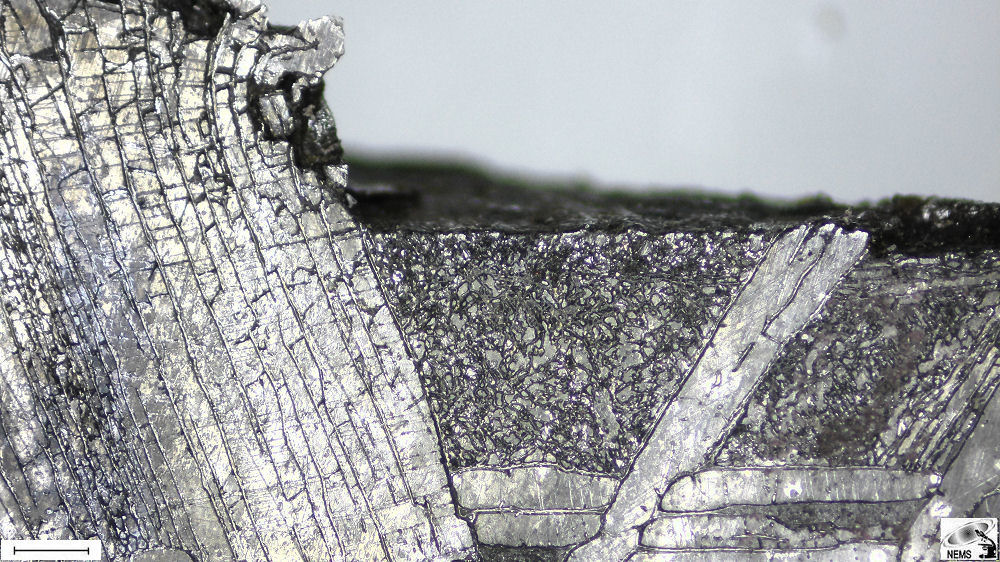 |
Figure 1. Scale bar 1.0 mm. |
| Meteorite, Bristol, IVA Iron. |
| Kamacite lamellae necking, two plessite fields--open mesh and decomposing comb plessite. |
| _____________________________________________________________________________________________________________________________ |
| |
| Open-Mesh Plessite and
Kamacite Necking in the Bristol IVA Iron Meteorite Figure 1. Kamacite lamellae exhibiting necking between two plessite fields (one open-mesh and one decomposing comb plessite) in the Bristol IVA iron meteorite. Scale bar=1.0 mm. Structural Description The Bristol meteorite (IVA group) is a fine octahedrite characterized by a Widmanstätten pattern formed through the slow exsolution and growth of kamacite (α-FeNi; body-centered cubic, low-Ni) lamellae within a parent taenite (γ-FeNi; face-centered cubic, higher-Ni) host during cooling in the parent body. In the illustrated region, kamacite lamellae display pronounced necking—localized thinning or constriction—adjacent to two distinct plessite fields. One field exhibits an open-mesh (net) texture, while the other shows features consistent with decomposing comb plessite. Plessite refers to a fine-grained intergrowth of kamacite and taenite (often including tetrataenite at lower temperatures) that typically forms in the residual taenite regions between Widmanstätten kamacite plates. Open-mesh plessite is characterized by a relatively coarse, interconnected network of kamacite boundaries enclosing taenite-rich areas, reflecting incomplete or arrested decomposition of martensite or taenite during cooling. Decomposing comb plessite represents a transitional microstructure where oriented kamacite precipitates (the “comb” or acicular elements) within taenite undergo further breakdown, often associated with the formation of cloudy zones or finer duplex textures. Necking Phenomenon in Kamacite “Necking” in iron meteorites describes the ductile deformation and localized thinning of kamacite lamellae, analogous to tensile necking observed in terrestrial metals under stress. This feature arises from plastic deformation under high strain rates, typically induced by shock waves from hypervelocity impacts in space or during atmospheric entry and fragmentation. In the Fe-Ni system of iron meteorites, kamacite is more ductile than taenite under many conditions, facilitating such deformation. Necking is evident where kamacite lamellae narrow significantly, often near interfaces with plessite or other heterogeneities that concentrate stress. In Bristol, a relatively fast-cooled IVA iron, these features highlight the meteorite’s complex post-formation history. Formation Context and Shock History Iron meteorites like Bristol originated as metallic cores (or core fragments) of differentiated asteroids. The IVA group is notable for its wide range of metallographic cooling rates (approximately 100–6,600 K/Myr), depletion in volatile siderophiles, and evidence of complex impact and thermal histories, possibly involving early collisional disruption of a larger parent body. Primary microstructures, such as the Widmanstätten pattern and plessite, formed during slow cooling over millions of years in the parent body. Secondary features like kamacite necking, Neumann lines (shock twins), and localized recrystallization are overprinted by later events: • Asteroidal impacts: Collisions generated shock pressures capable of plastic deformation without wholesale melting. • Atmospheric entry: Upon Earth impact, fragmentation and deceleration produced intense, localized stresses, particularly near surfaces or pre-existing weaknesses. Necking near the surface often indicates atmospheric breakup, whereas more pervasive deformation points to earlier catastrophic events in space. These are classified as secondary structures, post-dating the primary metallographic cooling record. Analytical Significance Microstructural studies of features like kamacite necking and plessite varieties, often combined with techniques such as electron backscatter diffraction (EBSD), transmission electron microscopy (TEM), and atom-probe tomography (APT), provide insights into deformation mechanisms, strain partitioning between phases, and the thermal-shock evolution of the IVA parent body. In Bristol specifically, high-resolution analyses have detailed kamacite–taenite interfaces and nanoscale Ni distributions, underscoring its fast-cooling characteristics relative to other IVAs. Such observations contribute to broader models of planetesimal differentiation, core formation, and the role of impacts in the early Solar System. |
| References • Rout, S. S., et al. (2017). “Atom-probe tomography and transmission electron microscopy of the kamacite–taenite interface in the fast-cooled Bristol IVA iron meteorite.” Meteoritics & Planetary Science. • Buchwald, V. F. (various volumes). Handbook of Iron Meteorites. • Goldstein, J. I., et al. (various papers on metallographic cooling rates and phase transformations in iron meteorites). • Yang, J., et al. (2007, 2008). Papers on IVA cooling rates and parent body history. • Additional sources from Meteoritical Society and peer-reviewed literature on plessite microstructures and shock deformation. |
| Listing of Structures |